12th September Website article Manusripts
Manuscripts
- Context: Recently PM Modi inaugurated International Conference on Reclaiming India’s Knowledge Legacy through Manuscript Heritage as a part of the Gyan Bharatam Mission.
What are Manuscripts?
- A manuscript is a handwritten composition on paper, bark, cloth, metal, palm leaf or any other material dating back at least seventy-five years that has significant scientific, historical or aesthetic value.
- Lithographs and printed volumes are not manuscripts. Manuscripts are found in hundreds of different languages and scripts.
- Often, one language is written in a number of different scripts. For example, Sanskrit is written in Oriya script, Grantha script, Devanagari script and many other scripts.
Importance of Manuscripts?
- Manuscripts are distinct from historical records such as epigraphs on rocks, firmans, revenue records which provide direct information on events or processes in history. Manuscripts have knowledge content.
Which Materials Used for Writing Manuscripts?
- Material is basically manuscripts which are found in various forms such as birch bark, palm leaf, handmade paper, cloth, leather etc. They are found in various shapes and sizes.
Examples of Ancient Manuscripts?
|
Important Themes of Manuscripts:
- Key themes include history, religion, literature, astrology, agricultural practices, philosophy, medicine, governance etc.
Government Steps to Preserve, protect, conserve Manuscripts:
Gyan Bharatam Mission (GBM):
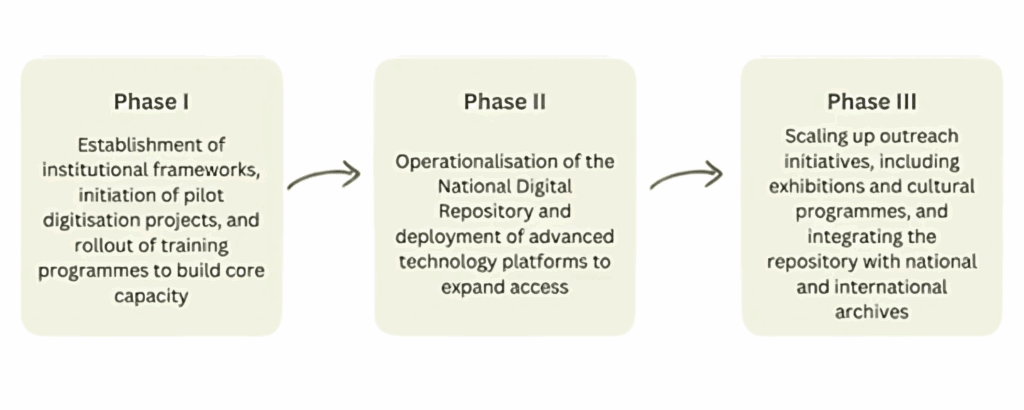
- Announced in Union Budget 2025-26, it is a national initiative to preserve, digitise, and disseminate India’s vast manuscript heritage, integrating tradition with technology for future generations.
- Gyan Setu National AI Innovation Challenge: Empowering youth and innovators to use technology for safeguarding heritage.
Objectives of Gyan Bharatam Mission:
- Identification & Documentation: Establish Manuscript Resource Centres (MRCs) to systematically catalogue manuscripts across institutions and private collections, creating a reliable national register.
- Conservation & Restoration: Strengthen Manuscript Conservation Centres (MCCs) to preserve fragile texts using scientific and traditional methods.
- Digitisation & Repository: Digitise manuscripts with AI-assisted Handwritten Text Recognition, microfilming, and cloud-based metadata to create a globally accessible National Digital Repository.
- Research, Translation & Publication: Revive rare manuscripts through critical editions, facsimiles, translations, and publications to integrate India’s heritage into global scholarship.
- Capacity Building & Training: Conduct training in transcription, palaeography, conservation, and manuscript studies to develop skilled scholars, conservators, and transcribers.
- Technology Development: Build digital tools, secure cloud storage, and IIIF-based platforms for efficient preservation and wider access.
- Engagement & Incentivisation: Encourage custodians to share collections via certification and revenue-sharing; engage scholars through exhibitions, digital content, and innovation labs.
- Global Collaboration & Education: Foster international partnerships, standardisation, and integration of manuscript knowledge into curricula, research, and skill development programmes.
Key Components of GBM:
- Conservation: Survey, document, and preserve over one crore manuscripts held by academic institutions, museums, libraries, and private collectors.
- Digital Repository: Establish a National Digital Repository of Indian knowledge systems, accessible to researchers, students, and institutions worldwide.
- Nodal Ministry: Ministry of Culture, Government of India.
Significance of the Mission:
- Cultural Duty: Upholds Article 51A(f) by valuing and preserving India’s rich and composite heritage.
- Documentation: Identify and record manuscripts across the country, including previously unknown collections, creating a comprehensive digital catalogue.
- Manuscript Studies: Develop a skilled pool of scholars and experts in various aspects of manuscript research.
- Conservation: Protect tangible cultural heritage while ensuring its availability for present and future generations.
- Accessibility: Provide wider and long-term access to rare and valuable texts.
- Collaboration: Promote collaborative research and resource sharing to strengthen knowledge systems.
Challenges in Manuscript Conservation
- Environmental Factors: India’s varied climate, especially high humidity in coastal and tropical regions, along with natural disasters, accelerates manuscript deterioration.
- Lack of Awareness & Cultural Neglect: Traditional knowledge in manuscripts is often undervalued in modern education, reducing urgency for preservation.
- Infrastructure Gaps: Shortage of trained professionals and inadequate storage facilities without climate control hampers proper conservation.
- Linguistic & Script Diversity: Manuscripts in ancient scripts (e.g., Brahmi, Kharosthi) complicate transcription, study, and preservation.
Way Forward
- Digital Preservation: Systematic digitization and advanced imaging ensure long-term access, enabling global scholarly research and education.
- 3D Printing: Laboratories, such as Tara Prakashana Vedic Library, use 3D printing to aid preservation and physical conservation of manuscripts.
- Artificial Intelligence: Inpainting AI algorithms, employed by institutions like the MACH Laboratory, detect damage and reconstruct missing or deteriorated parts of manuscripts using deep learning, spatial projections, and probabilistic modeling.
Value Addition:
Initiatives for Manuscript Conservation: About:
Objective:
Some Manuscripts and their Authors:
Constitutional and Legislative Provisions for Indian Heritage
|
- UPSC Mains Practice Question:
- Examine the importance of manuscripts in preserving India’s knowledge legacy. How does the Gyan Bharatam Mission contribute to their conservation and accessibility in the modern era?” (10 Marks, 150 Words)
Answer:
Introduction:
Manuscripts are handwritten documents preserving India’s scientific, literary, philosophical, and cultural heritage. They are vital for safeguarding centuries-old knowledge and connecting the past with the present.
Main Body:
Importance of Manuscripts in Preserving India’s Knowledge Legacy
- Ancient Knowledge: Ayurveda, mathematics, astronomy, literature, engineering, and arts.
- Cultural & Philosophical Heritage: Religious texts, epics, ethical treatises, and societal norms.
- Research Source: Authentic references for historians, linguists, and scholars.
- Revival of Traditional Practices: Yoga, classical music, architecture, and indigenous sciences.
- National Identity: Connects present generations to India’s past, instilling pride and continuity.
Contribution of Gyan Bharatam Mission:
- Digitization: Converts manuscripts to digital format for long-term preservation.
- Accessibility: Online access for researchers, students, and global academics.
- Translation: Converts ancient scripts into modern languages for wider understanding.
- Integration with Modern Knowledge: Supports blending traditional wisdom with contemporary science.
- Public Awareness: Exhibitions, seminars, and publications promote India’s manuscript heritage.
Conclusion:
Manuscripts are invaluable for conserving India’s knowledge legacy, and the Gyan Bharatam Mission ensures their preservation, accessibility, and relevance in the modern era.